
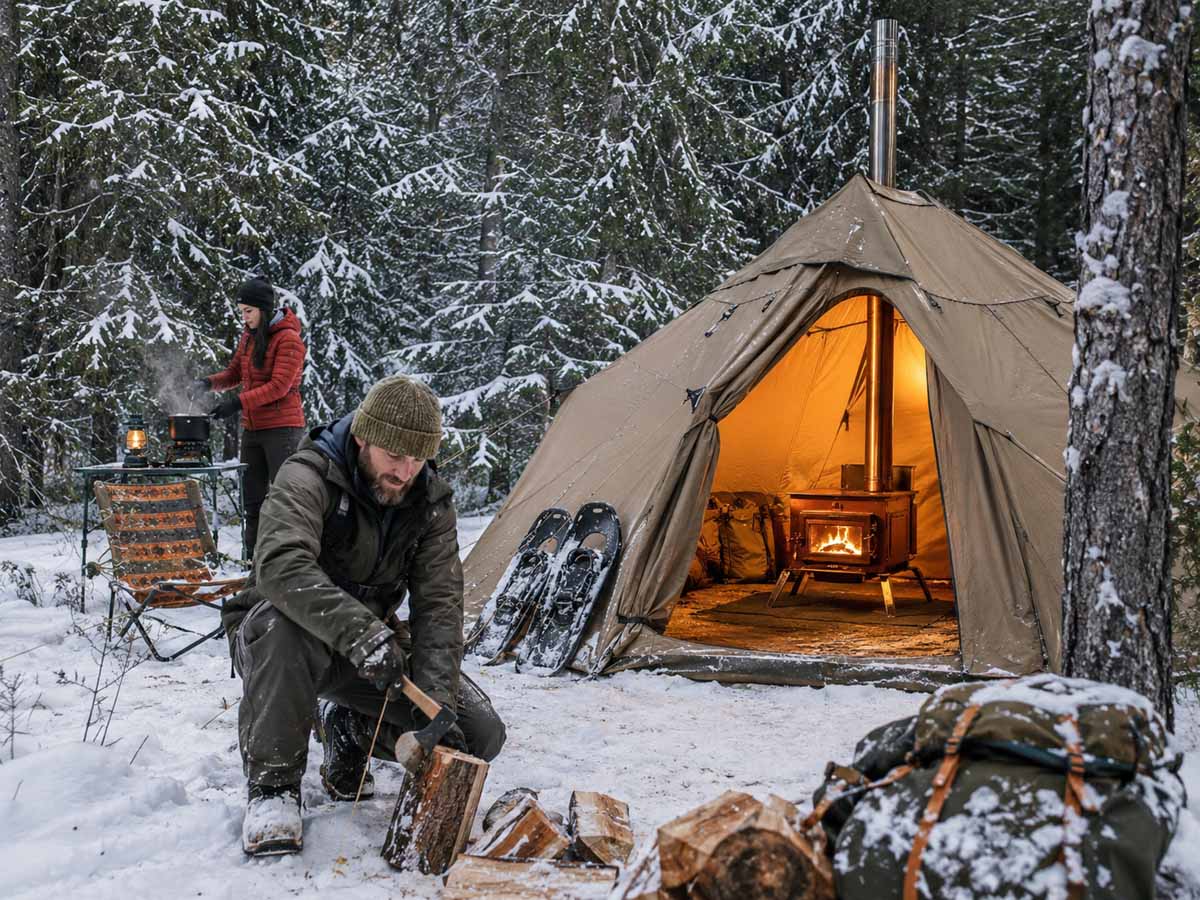

Are hot tents safe? They can be used only when the tent and wood stove are explicitly designed for the arrangement and every installation requirement is met. Even then, carbon monoxide, fire, and burns remain real hazards. A stove jack or a detector does not make an improvised setup safe.
If you’re asking are hot tents safe for winter camping, start with the entire system—not the stove’s Amazon rating. Here’s how to decide when to proceed, what equipment actually does, and when to walk away.
Affiliate disclosure: InfoBaswara may earn a commission from qualifying purchases when affiliate links are active, at no additional cost to you. Our recommendations are independently researched.
Are Hot Tents Actually Safe?
The practical answer to are hot tents safe is conditional: a manufacturer-approved tent, compatible stove and chimney, documented clearances, ventilation, and continuous supervision are prerequisites—not guarantees.
A hot tent isn’t simply a regular tent with a hole cut in its roof. If either manufacturer cannot confirm the configuration, don’t light the stove inside. The question are hot tents safe has no responsible yes-or-no answer without that context.
Three Risks Campers Underestimate
Carbon monoxide (CO): Incomplete wood combustion can produce this invisible, odorless gas. A chimney does not eliminate the possibility of leakage or backdraft. Ask “are hot tents safe?” after checking ventilation.
Ignition: Hot stove walls, embers, nearby gear, and chimney sections can ignite or damage shelter materials.
Burns and instability: Tight floor plans, loose chimney supports, and movement inside a tent increase exposure to hot metal.
So, are hot tents safe when the equipment looks professionally installed? Appearance isn’t evidence. Instructions and actual clearances matter. That is why “are hot tents safe?” demands evidence.
Carbon Monoxide Changes Everything
The U.S. Consumer Product Safety Commission (CPSC) warns that fuel-burning camping equipment can cause fatal CO poisoning. Headache, dizziness, nausea, weakness, and confusion may resemble ordinary camping fatigue. If an alarm sounds or poisoning is suspected, get everyone into fresh air immediately, call emergency services, and do not reenter until responders authorize it.
For anyone wondering are hot tents safe with a CO monitor, the answer is that monitoring adds a warning layer; it cannot compensate for poor ventilation or an unsuitable stove.
Equipment example — Forensics Detectors Travel CO Monitor, Version 2.0: Its manufacturer markets it for camping and lists a 25-parts-per-million (ppm) alert. However, published versions of its specifications differ, and one current product page lists a minimum operating temperature of 32°F (0°C). Verify the exact unit’s manual, battery endurance, alarm behavior, and temperature range before relying on it. Do not assume it works below freezing or substitutes for any required certified alarm.
View the Travel CO Monitor on Amazon
The better question than are hot tents safe with an alarm is whether the complete installation is approved and the alarm itself suits the conditions.
Stove Jacks Aren’t Enough
A stove jack is an exit point, not universal permission to route any hot pipe through fabric. For the Winnerwell Nomad and Woodlander Medium 2.5-inch system, the manufacturer specifies a matching triple-wall heat protector chimney and silicone flashing kit, stock-keeping unit (SKU) 910311. The protector must be installed at the third chimney section or higher.
Equipment example — Winnerwell Triple Wall Chimney 2.5-inch: This model illustrates why diameter, stove series, flashing hardware, and placement must be checked together. It is not a universal chimney shield. Confirm the exact model and follow both stove and shelter instructions.
View the Winnerwell chimney section on Amazon
Are hot tents safe with a triple-wall chimney alone? Not necessarily: Winnerwell specifically warns against using that protector without its compatible flashing kit.
Fireproof Mats Have Limits
A mat labeled “fireproof” may resist sparks without insulating a tent floor against sustained stove heat. Surface protection and a manufacturer-approved stove base are different jobs. The question “are hot tents safe?” includes floor protection.
Equipment example — POMOLY Fire Pit Mat: The listing targets outdoor fire pits and surface protection. We have not verified it as a substitute for the floor protection required beneath a hot tent wood stove. Use it only within its documented application and limitations.
If you’re asking are hot tents safe with an inexpensive mat, don’t use a material-temperature claim as proof of floor-system safety. Check the stove’s specified floor shield and required spacing instead.
Sleeping Changes the Risk
Are hot tents safe overnight? That question often hides a dangerous assumption: that a stove can be left burning while everyone sleeps. Do not leave a burning stove unattended or operate it while sleeping. The CPSC specifically warns against sleeping with portable fuel-burning heaters or lanterns in enclosed camping spaces.
Plan your sleep system for the outdoor temperature without relying on continuous stove heat. Wind shifts, blocked flues, and changing combustion conditions make unattended operation especially concerning.
For families asking are hot tents safe with children or pets, also consider traffic paths, barriers, and the possibility of accidental contact. If you cannot supervise the stove, extinguish it according to its instructions.
The Hot Tent Readiness Check
Here’s InfoBaswara’s decision tool. It turns are hot tents safe into six questions you can actually verify.
| Verify before lighting | If the answer is no or unknown |
| Both manufacturers approve the setup | Do not use the stove inside |
| Clearances and floor protection are documented | Stop and obtain instructions |
| Chimney, stove jack, and flashing match | Do not improvise components |
| Ventilation follows the manuals | Do not light the stove |
| CO monitoring suits the conditions | Resolve the monitoring gap; never treat it as permission to ignore other requirements |
| Someone can supervise throughout use | Do not operate the stove |
Decision rule: Any unresolved item means do not light the stove inside. Six confirmed answers permit further manufacturer-specific checks; they do not certify safety. Remember: “are hot tents safe?” is a system question.
This is the most useful way to answer are hot tents safe before buying another accessory.
Hot Tent Safety Questions
Do You Need a CO Alarm?
Yes, additional CO monitoring is prudent wherever the applicable manufacturer instructions permit fuel-burning equipment. Select a device documented for your temperature and conditions. But are hot tents safe because an alarm is present? No—alarms cannot prevent ignition or correct poor installation.
Can Any Tent Use a Stove?
No. When considering are hot tents safe, reject ordinary shelters without explicit stove approval. Canvas construction, a tipi shape, or an aftermarket stove jack alone is not sufficient evidence.
How Long Will It Stay Warm?
That depends on insulation, weather, and the stove’s operation. Are hot tents safe to heat through the night? Don’t plan on unattended burning; use a sleep system rated for expected conditions.
Safer Camping Starts With Decisions
Are hot tents safe? Only in a carefully verified, manufacturer-approved configuration—and never risk-free. The overlooked issue isn’t which accessory looks protective; it’s whether the stove, shelter, chimney, floor, ventilation, and operating routine work as one documented system.
Before purchasing, compare the three supporting products above against your own equipment, request missing instructions, and verify your stove choice against the shelter maker’s instructions. If any requirement remains uncertain, choose a no-stove setup instead. That’s the decision behind are hot tents safe that matters most.
Sources and Further Reading
- CPSC — Camping Equipment and CO
- CPSC — Carbon Monoxide Fact Sheet
- Winnerwell — Triple-Wall Protector Instructions
- Winnerwell — Flashing Kit Requirements
Forensics Detectors — Travel CO Monitor
