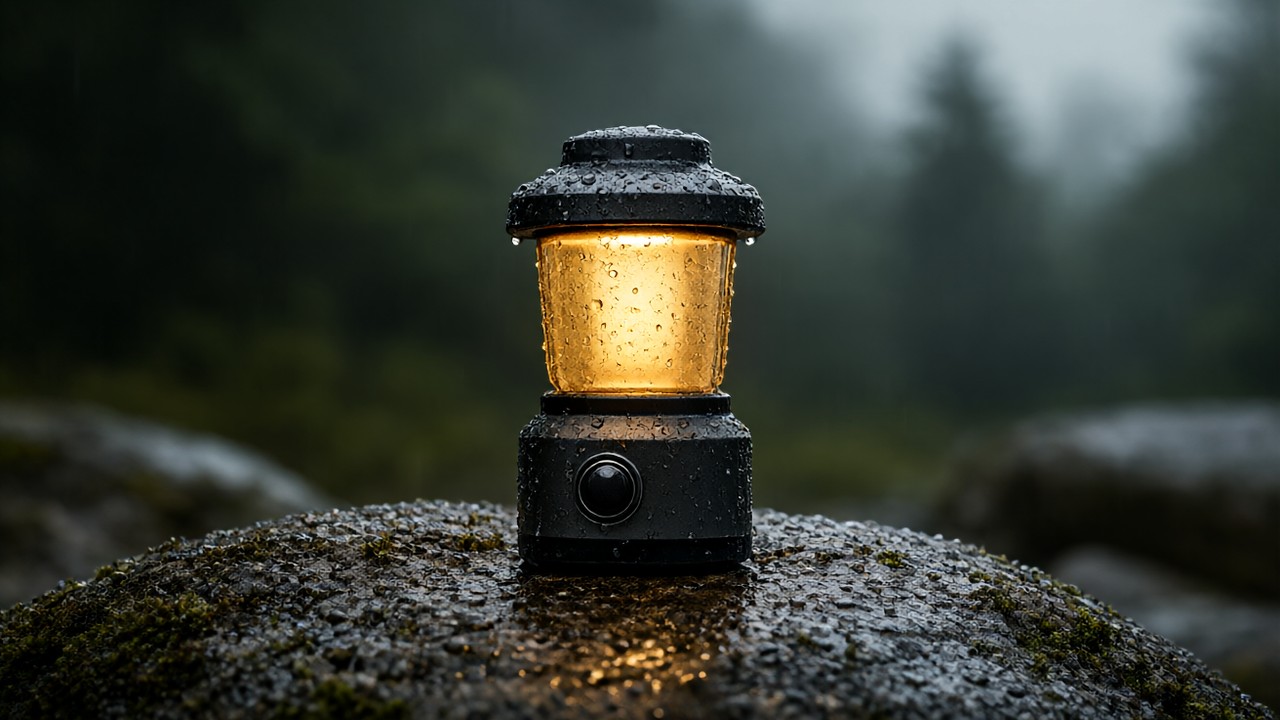

Waterproof camping lanterns matter the moment your trip involves rain, rivers, or morning dew. A splash-resistant lantern (IPX4) handles light rain. A submersible one (IPX7) survives a drop in a stream. The right rating depends on where you camp, not on marketing claims.
A waterproof camping lantern is a portable light with a tested ingress protection (IP) rating that specifies how much water and dust it survives. This guide explains IP ratings, matches them to camping styles, and shows what to buy.
The short version: for car camping and most weekend trips, IPX4 (splash-resistant) is enough. For canoe, kayak, backpacking in wet climates, or any trip near water, choose IPX7 or higher. Anything above IPX7 is overkill for camping.
Key facts: IP ratings use two digits: the first for dust (0 to 6), the second for water (0 to 8). IPX4 means splash-resistant. IPX7 means submersible to 1 meter for 30 minutes. IP67 or IP68 adds dust-tight. Most camping lanterns are IPX4; premium and outdoor-specific models reach IPX7 or IP68.
How IP Ratings Work
IP stands for Ingress Protection. The rating is two digits. The first digit rates dust protection (0 means none, 6 means dust-tight). The second rates water protection (0 means none, 8 means submersible beyond 1 meter). An “X” means that digit was not tested, not that it failed.
Common ratings you will see on camping lanterns:
- IPX0 or no rating: no water protection. Indoor or fair-weather only.
- IPX4: splash-resistant from any direction. Handles light rain, dew, and splashes. Fine for car camping and most weekend trips.
- IPX5 to IPX6: water-jet resistant. Handles heavy rain and hose spray. Good for exposed campsites.
- IPX7: submersible to 1 meter for 30 minutes. Survives a drop in a stream or a dunk in a lake.
- IPX8: submersible beyond 1 meter (depth and time specified by manufacturer). Premium spec.
- IP67 or IP68: dust-tight plus submersible. Best for dusty, wet, or sandy environments.
The first digit matters if you camp in dusty or sandy conditions. A dust-tight lantern (IP6x) keeps sand out of switches and battery compartments. For most camping, the water digit matters more.
Which Rating You Actually Need
Match the rating to the worst conditions you expect, not the average. A lantern that fails in a downpour ruins a trip.
Car camping and fair-weather trips: IPX4 is enough. Light rain and morning dew are the worst you will face. Most lanterns on the market are IPX4.
Backpacking in wet climates: IPX5 or higher. Rain, river crossings, and condensation inside a pack are real risks. A splash-resistant lantern may survive, but IPX6 gives margin.
Canoe, kayak, and boat camping: IPX7 or higher. Water and darkness are a dangerous combination. A submersible lantern that floats is ideal.
Winter camping: IPX4 or better, plus cold-rated batteries. Snow and ice are less water risk than rain, but melting snow inside a tent is a real hazard.
Beach and desert camping: IP67 or higher. Sand gets into everything. Dust-tight sealing protects switches and charging ports.
What to Look For Beyond the Rating
An IP rating is a test result, not a guarantee. Three things affect real-world water resistance.
Seal quality. O-rings and gaskets around battery compartments, charging ports, and buttons. A lantern with a good IP rating but a flimsy charging port cover will leak. Check the cover: it should be tethered, rubberized, and snug.
Charging port protection. USB ports are the weakest point. A covered port with a rubber flap is better than an exposed one. Some premium lanterns use wireless charging to eliminate the port entirely.
Drop rating. IP ratings do not test impact. A lantern that survives submersion may still crack if dropped on rock. Look for a published drop rating (1 meter or higher) if you camp on hard ground.
Waterproof vs Water-Resistant: The Marketing Trap
Brands use “waterproof” and “water-resistant” loosely. “Waterproof” with no IP rating means nothing. “Water-resistant” usually means IPX4. Only an IP rating tells you what the lantern actually survived in testing.
Be skeptical of claims like “weatherproof,” “all-weather,” or “rainproof” without an IP number. These are marketing words, not test results. If the spec sheet does not list an IP rating, assume splash resistance at best.
IP ratings are tested on new products. Seals degrade with use, UV exposure, and temperature cycles because rubber O-rings harden and flatten over time, losing their compression. A 3-year-old lantern may not match its original rating. Inspect seals annually and replace O-rings if they crack or flatten.
Verdicts by Camping Style
Picture a canoe tipping in a rainstorm at dusk: the lantern that floats and still works is the one worth buying. Match the rating to the worst conditions you expect.
Best for car camping and fair weather: any IPX4 rechargeable upright in the 200 to 400 lumen range. Budget $40 to $80. IPX4 handles light rain and dew. Most lanterns on the market fit this profile.
Best for backpacking in wet climates: a collapsible lantern with IPX6 or higher, under 8 oz, with 50 to 150 lumens. Budget $25 to $50. Look for sealed USB ports and a tethered charging cover.
Best for canoe, kayak, and boat camping: a floating lantern with IPX7 or higher and a lanyard attachment. Budget $30 to $60. Water and darkness are dangerous; a submersible lantern that floats is worth the premium.
Best for winter camping: a cold-rated rechargeable with IPX4 or better and an alkaline backup. Budget $40 to $80. IPX4 handles melting snow and condensation.
Best for beach and desert: a dust-tight IP67 lantern with sealed ports. Budget $50 to $100. Sand destroys switches and charging ports.
Features That Matter for Water Resistance
Sealed charging port. A rubber flap or magnetic cover over the USB port. The best designs have a tethered cover that stays attached when open.
Drainage channels. Some lanterns have small channels that let water escape from around the battery compartment. Useful in heavy rain.
Floating design. Some lanterns are designed to float if dropped in water. Essential for canoe and kayak camping.
Lanyard or carabiner. A way to attach the lantern to your pack, boat, or tent loop. Prevents drops in the first place.
Simple controls. A single button or dial is easier to operate with wet or cold hands than touch controls or multi-button sequences.
Common Mistakes
One insight that surprises first-time buyers: the IP rating tests the lantern as manufactured, not as used. A lantern that survives IPX7 in the lab can leak after a season of UV exposure, temperature cycles, and a few drops. The rating is a starting point, not a lifetime guarantee. Inspect seals annually.
Trusting “waterproof” without an IP rating. Marketing words mean nothing. Only an IP number tells you what was tested.
Ignoring the charging port. The port is the weakest point. A covered, tethered port is essential for wet-weather use.
Skipping seal maintenance. O-rings degrade. Inspect annually and replace if cracked or flattened.
Buying IPX7 for car camping. Overkill and expensive. IPX4 is enough for fair-weather and car camping.
Forgetting the drop rating. IP ratings do not test impact. Check the drop rating if you camp on rock or hard ground.
When Waterproof Is Overkill
IPX7 is not always necessary. Three cases where IPX4 is enough.
Car camping in fair weather. Light rain and dew are the worst you will face. IPX4 handles both.
Indoor and RV use. No water exposure. IPX4 is overkill; even IPX0 works.
Budget constraints. IPX7 lanterns cost $20 to $40 more. If you camp in dry conditions, spend the money on brightness or battery instead.
Putting It Together
Match the IP rating to the worst conditions you expect, not the average. IPX4 for car camping and fair weather, IPX6 for backpacking in wet climates, IPX7 or higher for canoe and kayak. Check the charging port cover and drop rating before buying.
For the full selection framework, see our LED camping lanterns complete guide. For a buying guide, read our best LED camping lanterns guide. For tent-specific picks, see our best camping lanterns for tents.
Related reading: solar, kids, budget, and power-bank camping lantern guides.
If you camp in a hot tent, your lighting choice interacts with stove safety. See our hot tent stove guide.
Last updated: 2026-11-17. Editorial guide based on published IP ratings and manufacturer specifications. Amazon affiliate links may appear.