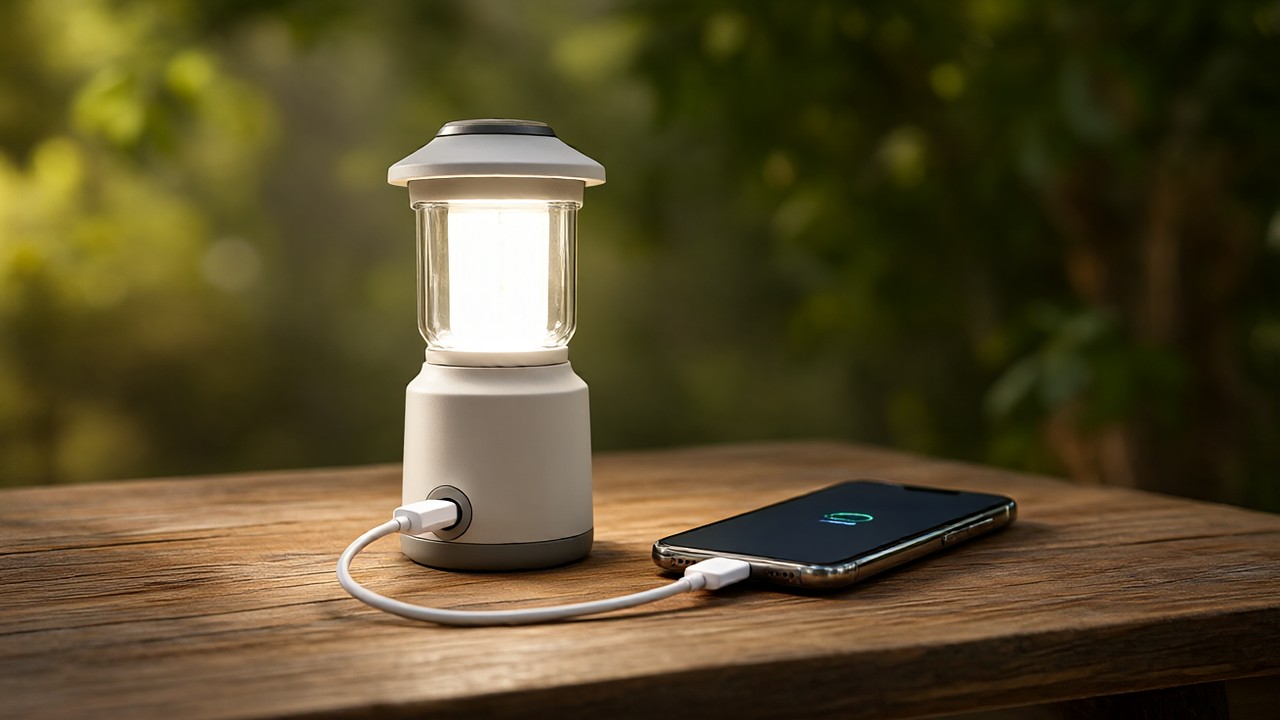

Camping lanterns with power bank output solve two problems at once: they light your campsite and charge your phone, headlamp, or GPS. The feature is genuinely useful on multi-day trips, but the output is slow and drains the lantern battery.
A camping lantern with power bank output is a portable light with a built-in USB output port that charges external devices from the lantern’s battery. This guide explains how power-bank lanterns work, when they are worth it, and what to buy.
The short version: a power-bank lantern is worth it if you camp more than two nights or carry devices that need charging. Choose a 300 to 500 lumen model with 8,000+ mAh, USB-C input and output, and IPX4 or better. Budget $60 to $120. The power bank is a backup, not a primary charger.
Key facts: USB output from a lantern is typically 1 to 2 amps (5 to 10 watts), slower than a wall charger. Charging a phone drains 20 to 30 percent of a 5,000 mAh lantern battery. The feature is most useful on multi-day trips where no outlet exists. Power-bank lanterns cost $20 to $50 more than equivalent models without the feature.
How Power-Bank Lanterns Work
A power-bank lantern has a USB output port in addition to the charging input. The lantern’s battery supplies power to the port, which charges an external device. The port is usually USB-A or USB-C, with output of 1 to 2 amps.
The lantern prioritizes its own LED. When you turn the light on, the battery powers both the LED and the USB output. On high brightness, the USB output may be reduced or disabled to protect the battery.
On low or off, full power goes to the USB port. The USB output is slow (1 to 2 amps) because the lantern’s battery management circuit limits discharge rate to protect the cell, and voltage conversion from 3.7V (Li-ion) to 5V (USB) loses 10 to 15 percent as heat.
Capacity matters. A 5,000 mAh lantern can charge a phone once (roughly 3,000 mAh) with some left for light. A 10,000 mAh lantern can charge a phone twice and still run for an evening. Below 3,000 mAh, the power bank feature is not worth the cost.
When a Power-Bank Lantern Is Worth It
Multi-day trips (3+ nights). No outlets means every device charge counts. A lantern that charges your phone or headlamp is a real asset.
Family camping. Multiple devices (phones, tablets, GPS) need power. A lantern with USB output covers emergencies.
Backpacking with electronics. GPS, satellite messenger, and headlamp all need power. A lantern that doubles as a power bank saves weight.
Emergency and disaster prep. A lantern that charges a phone during a power outage is genuinely useful.
When It Is Not Worth It
One insight that surprises first-time buyers: a dedicated 10,000 mAh power bank costs $15 and charges faster than any lantern’s USB output. The lantern’s power bank is worth it only when weight and packing matter (backpacking) or when you want one device instead of two (family camping). For car camping, buy a separate power bank.
Weekend trips (1 to 2 nights). A small power bank is cheaper and lighter. The lantern’s USB output is slow and drains light time.
Car camping with vehicle access. You can charge devices from the car. The lantern’s power bank is redundant.
Low-capacity lanterns. Below 3,000 mAh, the power bank feature drains the battery too fast to be useful.
If you already carry a power bank. A dedicated 10,000 mAh power bank is cheaper, lighter, and charges faster than a lantern’s USB output.
Power-Bank Lantern Profiles
| Profile | Lumens | Battery | USB output | IP rating | Price | Best for |
|---|---|---|---|---|---|---|
| Family (power bank + light) | 300 to 500 | 8,000 to 10,000 mAh | USB-A + USB-C | IPX4+ | $80 to $120 | Family camping, multi-day |
| Backpacking (light + top-up) | 100 to 200 | 3,000 to 5,000 mAh | USB-A | IPX6+ | $50 to $80 | Weight-conscious hikers |
| Emergency (reliability first) | 100 to 300 | 5,000+ mAh | USB-A | IPX4+ | $40 to $70 | Emergency kits, power outages |
| Budget (basic power bank) | 100 to 200 | 3,000 to 5,000 mAh | USB-A | IPX4+ | $30 to $50 | Occasional campers |
Most buyers need the family or backpacking profile. The emergency profile suits power-outage prep. The budget profile is for occasional use.
What to Look For
Battery capacity. 5,000 mAh minimum for a useful power bank. 8,000+ mAh for family or multi-day use. Below 3,000 mAh, the feature is not worth it.
USB-C input and output. USB-C charges faster and uses the same cable as your phone. USB-A output is fine for older devices.
Output current. 1 amp is slow (emergency top-up). 2 amps is faster (practical charging). Check the spec before buying.
Pass-through charging. Some lanterns charge their own battery while outputting power to a device. Useful if you have a solar panel or power bank feeding the lantern.
IP rating. IPX4 or better. The USB port is the weakest point. A covered, tethered port is essential.
Common Mistakes
Picture a camper on day three, phone at 2 percent, wishing they had bought the lantern with the USB output instead of the one with 200 extra lumens. Five mistakes to avoid.
Expecting fast charging. Lantern USB output is 1 to 2 amps, slower than a wall charger. A phone takes 2 to 3 hours to charge fully.
Draining the battery. Charging a phone drains 20 to 30 percent of a 5,000 mAh lantern. Plan your light time accordingly.
Buying low capacity. Below 3,000 mAh, the power bank feature is not worth the premium. Spend the money on a dedicated power bank instead.
Ignoring the IP rating. The USB port is the weakest point. A covered, tethered port is essential for wet-weather use.
Using it as a primary charger. A lantern’s USB output is a backup, not a primary charger. Carry a dedicated power bank for regular charging.
Verdicts by Use Case
Best for families: a 300 to 500 lumen lantern with 8,000+ mAh, USB-C input and output, and a frosted globe. Budget $80 to $120. It lights the tent and charges phones on multi-day trips.
Best for backpacking: a 100 to 200 lumen lantern with 3,000 to 5,000 mAh, USB-A output, and IPX6 or better. Budget $50 to $80. Light enough to carry, useful enough to justify the weight.
Best for emergency prep: a 100 to 300 lumen lantern with 5,000+ mAh, USB-A output, and a hand crank or solar backup. Budget $40 to $70. Reliability over brightness.
Best budget: a 100 to 200 lumen lantern with 3,000 to 5,000 mAh and USB-A output. Budget $30 to $50. Basic but functional.
When to skip: if you camp one or two nights, or already carry a power bank. A dedicated power bank is cheaper and charges faster.
When a Power-Bank Lantern Is the Wrong Choice
A power-bank lantern is not always the right choice. Three cases where a separate power bank wins.
Car camping with vehicle access. You can charge devices from the car. The lantern’s power bank is redundant.
Short trips (1 to 2 nights). A small power bank is cheaper and lighter. The lantern’s USB output is slow and drains light time.
High charging needs. If you need to charge multiple devices fully, a dedicated 10,000 mAh power bank is cheaper and faster.
Putting It Together
A power-bank lantern is worth it on multi-day trips, for families, and for emergency prep. Choose 5,000+ mAh, USB-C input and output, and IPX4 or better. The power bank is a backup, not a primary charger.
For the full selection framework, see our LED camping lanterns complete guide. For brightness numbers, read our lumens guide. For power source trade-offs, see our rechargeable vs battery comparison. For a buying guide, read our best LED camping lanterns guide. For family camping, see our best camping lanterns for families. For rechargeable picks, see our best rechargeable camping lanterns.
Related reading: kids and budget camping lantern guides.
If you camp in a hot tent, your lighting choice interacts with stove safety. See our hot tent stove guide.
Last updated: 2026-11-17. Editorial buying guide based on published specifications and ANSI FL1 standards. Amazon affiliate links may appear.